

There are plenty of good reasons to criticise Andy Burnham, but his ancestry isn’t one of them.
Unless, that is, you chair a branch of Reform UK.
David Bowes stood for the party in Scarborough and Whitby in 2024, coming third with more than 9,500 votes.
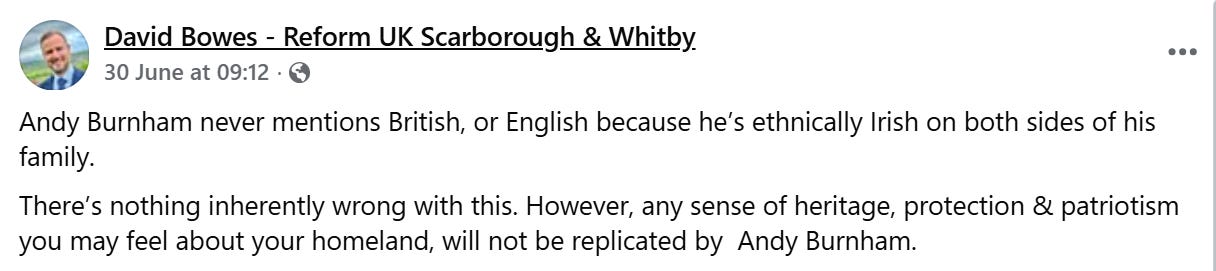
Last month, he wrote on his Reform-branded Facebook page: “Andy Burnham never mentions British, or English because he’s ethnically Irish on both sides of his family.”
Bowes explained: “There’s nothing inherently wrong with this. However, any sense of heritage, protection & patriotism you may feel about your homeland, will not be replicated by Andy Burnham”.
Let’s forget about Burnham’s aversion to media scrutiny and his propensity to waste taxpayers’ money so we can worry about where his grandparents were born. That’ll really make him sweat.
The irony is that Bowes’s amateur genealogy isn’t even accurate. In a nod to his mother’s family name, Burnham’s middle name is Murray and in interviews he’s mentioned Welsh roots.
In 2013, he described his identity as “all mixed up”. And millions of people living in England would say the same.
Families from our islands and beyond have crossed borders and settled in new places for centuries. Way back in 1851, more than 700,000 Irish-born people were living in Britain. Their place of birth does not make their descendants any less ‘English’.
Granted, too many recent newcomers are reluctant to embrace English or British identities. But that is their choice, not a product of their ancestry.
Whatever one thinks of mass migration, after decades of it we ought to build a national identity that immigrants can adopt with pride, rather than telling them they will never belong.
Bowes, however, appears fixated on a mythical vision of Englishness.
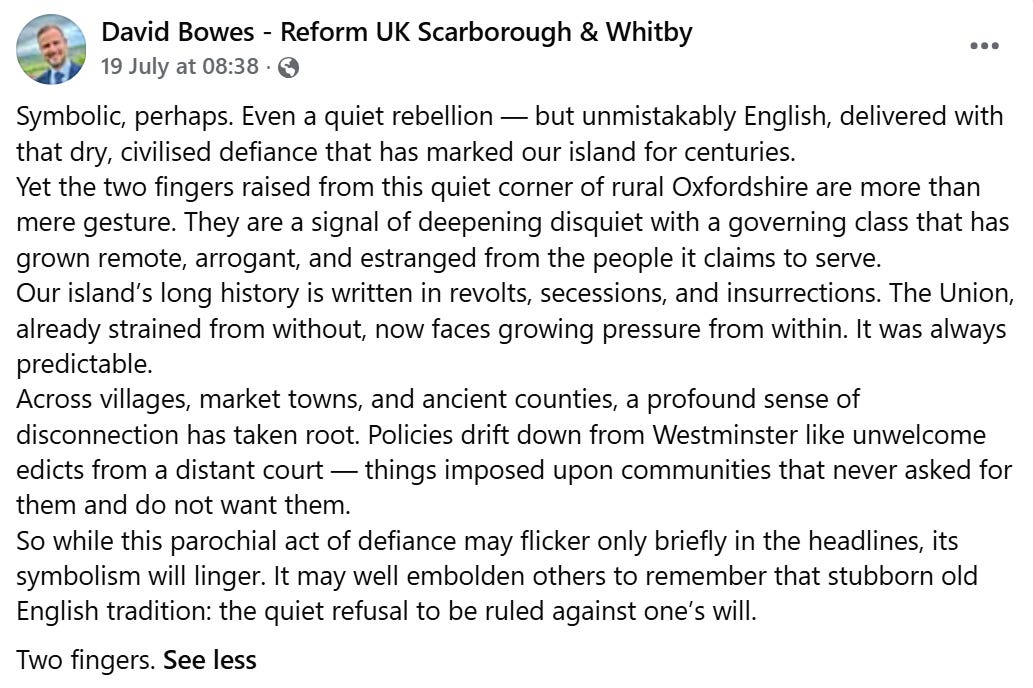
When the Oxfordshire village of Piddington voted to hold an independence referendum, he took to Facebook to celebrate the “stubborn old English tradition” of refusing “to be ruled against one’s will”. Never mind the fact it is England from which the villagers are trying to become independent.
He compared Westminster policies to “unwelcome edicts from a distant court” and presented English history as a series of “revolts, secessions, and insurrections”.
This is an adolescent reading of history. Britain’s political tradition was shaped less by revolution than by turning conflict into institutions. Magna Carta, Parliament and common law are all expressions of this fine conservative habit.
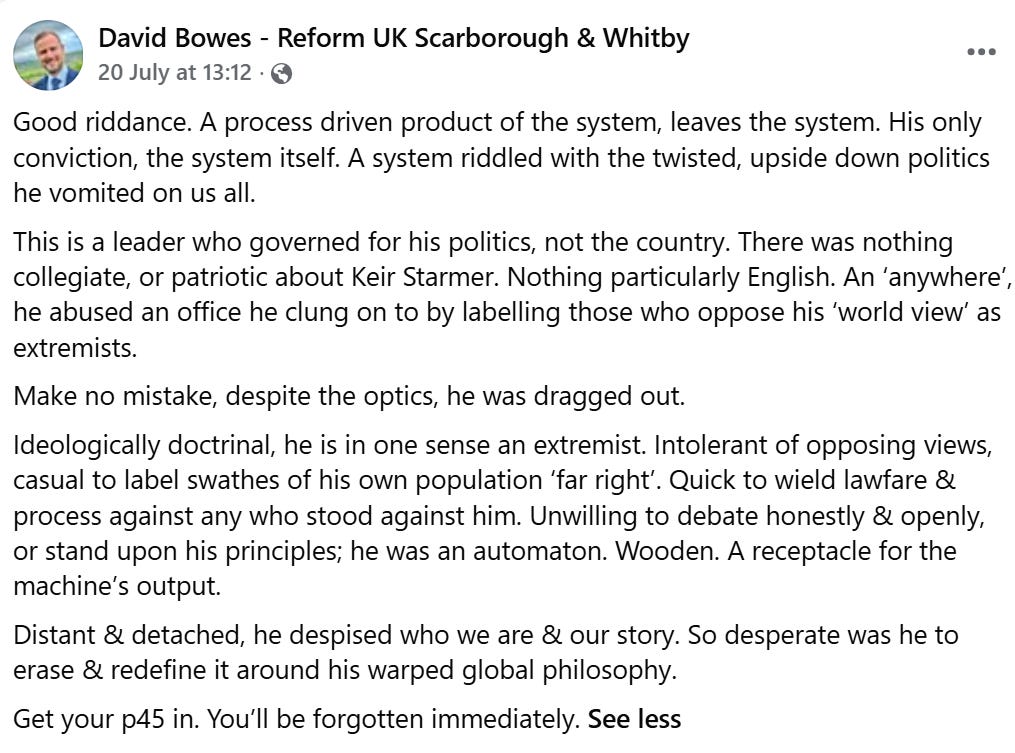
Bowes also claimed there was “nothing particularly English” about Keir Starmer and accused him of despising “who we are & our story”.
Starmer wrapped himself in the flag, made Labour sing the national anthem and rescued the party from a leadership that would have taken Britain out of NATO and allowed antisemitism to fester within its ranks.
He chose public service over a legal career that could have made him considerably richer. Regardless of his achievements in office, these are hardly the actions of a man who lacks patriotism.
Bowes is not a lone voice; he is echoing Reform’s most prominent thinkers.
Matt Goodwin has argued that “Englishness is an ethnicity that is deeply rooted in a people that can trace their roots back over generations”. Reform’s policy chief, James Orr, put it more philosophically, asking: “If anyone can become an Englishman, what is an Englishman?”
Some of our greatest patriots would have had something to say about that. Churchill’s mother was American, Disraeli was the grandson of an Italian immigrant, Richard the Lionheart couldn’t even speak English.
I can’t help taking this a tiny bit personally. My grandfather moved here from the Netherlands. By Reform’s logic, I’ll never be English. But perhaps I should look on the bright side and take the chance to free myself from ritual World Cup heartbreak.
Besides, having grown up on the Welsh border, I have always felt British first, English second.
Millions of people across England feel the same. The 2023 British Social Attitudes survey found that 45 per cent felt English and British in equal measure, while 22 per cent considered themselves predominantly British. Just 23 per cent identified as primarily or exclusively English.
That ought to be food for thought for a party struggling to push beyond the mid-twenties in the polls. Voters in Scotland and Wales will also be taking note. If Reform aspires to govern Britain, they cannot make English ancestry the basis of belonging.
By doing so, they are giving Andy Burnham the opportunity to defend an inclusive British identity against divisive English nationalism. He couldn’t have scripted it better himself.