

YouTube has been feeding me episodes of Boiling Point, the 90s fly-on-the-wall documentary that made Gordon Ramsay a household name.
I’d last seen it 15 years ago, on a blurry DVD above my parents’ gastropub. Shouty chefs were the soundtrack to my childhood. So Ramsay’s ranting and raving seemed natural to me, funny even. He belittled waiters and squared up to chefs because he wanted to be the best. They probably deserved it.
Kitchen culture has come a long way since Ramsay was chasing his third Michelin star. Open kitchens now create cool, almost staged, atmospheres. I’m never comfortable in that tranquillity, nor with the implication that chefs are performers diners are paying to watch. The kitchens I knew were not theatres. They were places of hissing pans, sweating brows and cries of “service” - places that rightly remained hidden from view.
I’m amazed Ramsay let the cameras in. After he became the first pub chef to win a Michelin star, my father turned a similar documentary down, knowing exactly how ugly a working kitchen could look from the outside.
On second watching, I found Ramsay’s behaviour excruciating. When a certain kind of chef smells weakness, they latch on to it and don’t let go - this is not unique to Ramsay. Like all good bullies, they perform for an audience, relish a rhetorical question, and keep niggling until another target appears.
On the day of his Michelin inspection, Ramsay demotes two of his chefs on the spot:
“You, as from now on, are a commis (the lowest rung on the kitchen ladder). And you are a fucking commis. Don’t like that? Give me your notice and fuck off. Commis. Commis.
“Feel Happy now? Less stressed? Want to have a little cry?
“I don’t give a fuck if you go, I won’t miss dickheads, never ever, ever, ever.”
Repetitive and cruel. But what’s more remarkable is how quickly Ramsay shifts from blind rage to reflective zen.
Later that night he muses to the camera: “The whole 47 covers tonight was a total dream, everything went to perfection…And it all filtered through my hands, it was perfect.”
It all went through his hands. The people who actually cooked the food were supporting actors, almost irrelevant. Ramsay was the top dog. And how do top dogs stay there? By putting everyone else down.
Observe how Ramsay dresses down the unfailingly loyal Sergeant when he fails to order enough salad:
“Hey you, as a 25 year old junior sous chef, yeah, there’ no fucking salad in the place…
You reckon you’re the same as I was at 25? You’re fucking ten miles away, big boy.”
I’m embarrassed to admit I used to think treating people that way was acceptable. And I suspect Ramsay is too - he’s never watched Boiling Point from beginning to end. But the truth is that without it, there would have been no Kitchen Nightmares, no Hell’s Kitchen, no restaurants in every corner of the globe, no Netflix documentaries, no celebrity love-ins with the Beckhams, no easy gigs and power couple marriages for his kids.
The bullying wasn’t a blemish on the brand; it was the brand, 90s cheekiness and putting two fingers up to polite society on steroids. It made Ramsay his multi-million-pound fortune, money that we chose to give him. We went to his restaurants, watched his TV shows, read his books, bought the pots and pans he endorsed. We made him the face of British food. That says as much about us as it does about him.
In the Boiling Point era Ramsay was striving for something. His passion, drive, and standards were extraordinary. Royal Hospital Road was one of the most exciting restaurants in the world, and his only other restaurant, Pétrus, also held a Michelin star. I know that I shouldn’t, but I still respect him for achieving that. Too few people born on Britain’s council estates become the best in the world at anything.
Drunk on this cocktail of disgust and admiration, I decided to do something I’d never done before: eat Ramsay’s food. Yes, I am part of the problem.
Freshly unemployed, the budget wouldn’t stretch to a £125 a head lunch at Royal Hospital Road. So we hopped up the Northern Line to the Charing Cross outpost of Gordon Ramsay Street Burger.
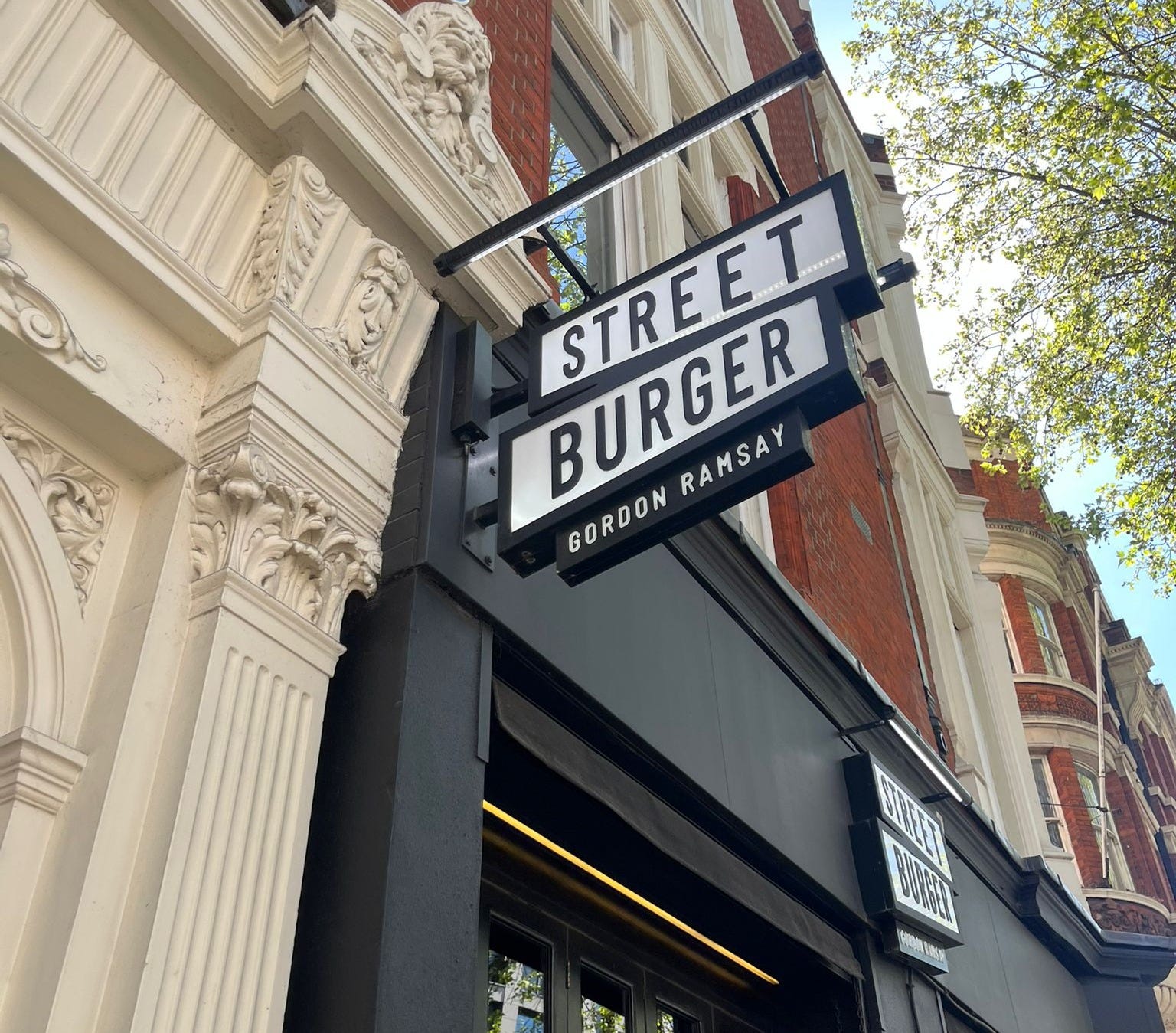
What I walked into wasn’t a restaurant; it was the arse end of a corporate machine that’s been built purely to make profit. Every expense was spared. The merest hint of hospitality was absent.
Having refused to commune with the QR codes on the menus, a waiter with an iPad begrudgingly bustles over to take our order. Could I swap the chips with my burger for salad? “The system won’t allow it.” In honour of Ramsay: FUCK your system. Fuck your tablet. And while you’re here, fuck trying to make me order on an app.
What does our country’s most famous chef sell on draft? Peroni, that renowned British lager. A Pepsi? That’ll be £4.95, thank you very much. Perhaps you fancy washing down your burger with a £69 bottle of Chablis? Not even the Chinese tourists were gullible enough to fall for that.
Could I have some mayonnaise to dip my chips in? Yes, as long you pay £2 for the privilege. But rejoice, the knockoff ketchup is free.
The gluten free was more like a Warburton’s bap. My O.G.R burger was cremated; the other half’s Chilli Cheese Smash swam in its own grease. If Ramsay had been served either on Kitchen Nightmares, they would have ended up back on the plate.
The only palatable bit was the chips - perhaps the system knew best after all.


This isn’t anti-burger bias. For just a couple of quid more, you can get your hands on Black Bear’s orgasmic Miso Bacon Burger. Trust me, it’s addictive. And I don’t want to denigrate Ramsay’s staff - they’re not responsible for this mess, he is.
A man who was once Britain’s greatest chef has been reduced to copying Pizza Hut’s bottomless ice cream. He even tried to sell me a £10 pair of ‘Street Burger’ branded socks on the way out. No thanks, big boy.
The grim irony is that the old Ramsay at least bullied people in pursuit of something. It was ugly, indefensible and cruel, but attached to standards. Street Burger offers the worst of both worlds: the aggression of the brand without the excellence that gave it cover.
Great restaurants require pressure, stamina, discipline, standards, and hours most people would consider unreasonable. But they do not require a chef that turns every mistake into a public humiliation. And they certainly do not require a £2 pot of mayonnaise.
Ramsay’s genius was making us believe bullying was the price of brilliance. The sadness, all these years later, is seeing how little brilliance is left.